

THANK YOU FOR SUBSCRIBING
A featured contribution from Leadership Perspectives: a curated forum reserved for leaders nominated by our subscribers and vetted by our Manufacturing Technology Insights Advisory Board.

Through this article, Britt Howard emphasizes the importance of mastering the basics of safety leadership in creating and maintaining a safe work environment. He outlines the foundational Three E's and expands them into the Ten E's in Safety Leadership, highlighting the need for a balanced integration of traditional and innovative safety practices. Britt also underscores the necessity of anticipating, recognizing, analyzing and controlling hazards to ensure effective, safe work planning and execution.
I recently attended a North America HSE Summit in Austin, TX, focusing primarily on the Mature elements of a Safety Culture and Engaged Safety Leadership. As I was completing the last day of the summit, I thought about the developing leaders who need to understand and utilize the basics of safety leadership before they can genuinely deploy mature safety leadership techniques. The Three E’s in Safety Management is how I was “baptized” in the safety discipline academically (Marshall University Graduate School 1992 - 1994) and where the work is done (Allide Colloids Chemical Company in 1995).
Those Three E’s are:
● Engineer out the Hazard
● Educate the work-family member to recognize and manage the hazard through policy and procedures
● Enforce compliance with the policy and procedures that drive safe work planning and execution
Over the years, I expanded the Three E’s until I landed on a fundamental Ten E’s in Safety Leadership that I wrote in 2009.
The Ten E’s in Safety Leadership was progressive at the time and helped me and others serve our work families in the right areas of safety leadership.
1. Expectations - acknowledge all work family members of what you want them to do.
2. Explanation - explain why it is essential for the work-family to work safely.
3. Example - everyone follows the same safety rules.
4. Engineering - eliminating as many hazards as possible through physical design.
5. Education - train everyone on how to deal with hazards.
6.Execute - put incident prevention plans into practice.
7. Enforcement - deliver compliance to the established expectations.
8. Encouragement - recognize expectation compliance/goal achievement through verbal appreciation/gifts.
9. Embracement - the stakeholders adopt the idea of working safely all of the time
10. Excitement - promote safety excitement with all work family members.
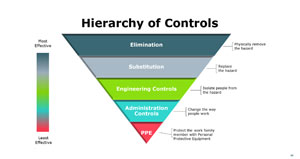 Sometimes, we get too far apart or ahead of the Basics when Planning and Executing Safe Work. No matter how sophisticated the safe work tools, procedures and equipment are, the basics still apply to create and maintain a safe work experience.
Safe Work Planning – Anticipating, Recognizing, Analyzing and Controlling the hazards associated with completing the work.
Anticipating Hazards – Consider the present hazards and the hazards that could emerge (e.g., harsh weather, wild animals, work-family member incompetence, equipment failure and others).
Recognizing Hazards—Identify hazards (e.g., current harsh weather, local wild animals, known work family member incompetence, identified equipment failure and others).
Analyzing Hazards—Measuring the risk associated with the Anticipated and Recognized Hazards (e.g., harsh weather, wild animals, work-family member incompetence, equipment failure and others).
Controlling Hazards—Deciding on the Level or Hierarchy of Hazard Control based on the measured level of risk associated with the Anticipated and Recognized Hazards (e.g., harsh weather, wild animals, work-family member incompetence, equipment failure and others).
When organizations and work families become too focused on the latest and greatest safety technology and innovation (e.g., artificial intelligence, human organization performance, psychosocial safety and robots/drones), the Basics in Safety Leadership can be ignored.
The integrated focus on the basics and innovative safety leadership elements should be utilized to deliver a balanced safety program. The Three E’s, along with “Evolving” (Safety Evolution), as another “E,” should be the balance that safety leadership uses to create, nurture and sustain safe work experiences:
● Engineer out the Hazard
● Educate the work-family member to recognize and manage the hazard through policy and procedures
● Enforce compliance with the policy and procedures that drive safe work planning and execution
● Evolve the safety process’, equipment, technology and others to create a safer work experience for the work family.

Manufacturing Technology Insights Weekly Brief
Be first to read the latest tech news, Industry Leader's Insights, and CIO interviews of medium and large enterprises exclusively from Manufacturing Technology Insights
